Phase & Thermodynamics
PHASE BOUNDARY & DENSITY SOLVER
Bubble/dew solve on a known coordinate, or the full P-T phase envelope and coexistence boundaries.
- Peng-Robinson (1976) equation of state
- Spencer-Danner Rackett liquid volume correction
- Wilson correlation (initial K-values)
- Rachford-Rice flash
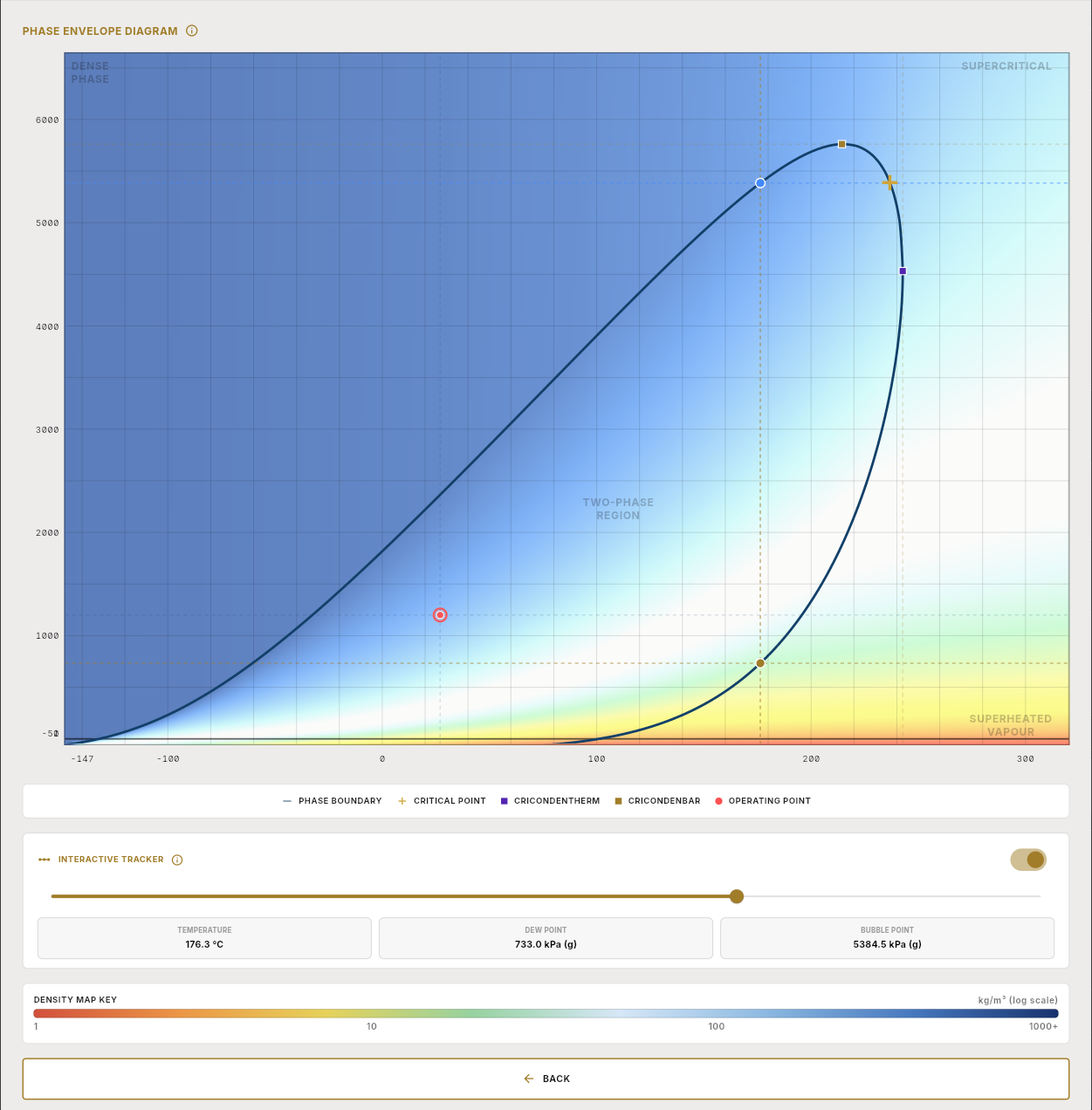
Phase Boundary & Density Solver establishes where a hydrocarbon mixture sits relative to its phase envelope, and its density at that point, from composition, pressure and temperature alone. It runs on the same Peng-Robinson engine that supplies fluid properties to the rest of the ALKANE suite.
Capabilities
- Traces the full pressure–temperature phase envelope and locates the critical point, cricondentherm and cricondenbar.
- Solves the bubble or dew coordinate directly along a single isotherm or isobar.
- Places an operating point against the envelope and reports its phase state.
- Reports saturated vapour and liquid density at the operating point, alongside the flash-weighted bulk density.
- Reports the width of the two-phase region and the subcooling or superheat margin to the nearest boundary.
- Reports the composition’s molar mass and pseudo-critical point.
- Plots the envelope over a density topology map of the P–T plane.
Why the results hold up
Vapour–liquid equilibrium is solved with the Peng-Robinson (1976) equation of state to equal-fugacity convergence. Wilson-correlation K-values provide the starting estimate, and an iterative Rachford-Rice flash refines it, with analytical methods used throughout for numerical stability. A Michelsen (1982) tangent-plane-distance stability test determines whether the mixture splits, so a phase split is only reported where one is thermodynamically real. The envelope is traced by arc-length continuation, and a wide-boiling composition with a genuine break in its saturation curve is reported with that break, not bridged onto an unrelated root.
Mixture behaviour rests on the binary interaction parameters as much as on the equation of state. ALKANE applies them through quadratic van der Waals mixing rules. For contaminant pairs (CO2, H2S and N2), it uses Fateen, Khalil & Elnabawy (2013) where that paper covers the pair, and checks the remainder against an independent reference implementation. Hydrocarbon–hydrocarbon pairs use a correlation that increases with the separation between components. Liquid volumes carry a Spencer-Danner Rackett correction.
Where the traced boundaries cannot place an operating point in a single region, the state is reported as undetermined rather than assigned.
Verification
ALKANE’s V&V Diagnostics includes fluid mechanics and mixtures suites, which check this engine against published reference data. Details are on Validation & Verification.
Scope
Coexisting-phase properties become numerically ill-conditioned within about 5% of the true critical point. For heavy gas condensates the calculated cricondenbar is a mathematical lower bound rather than a measured ceiling. Confirmation against laboratory PVT data is recommended before an operational threshold is taken from either figure.